


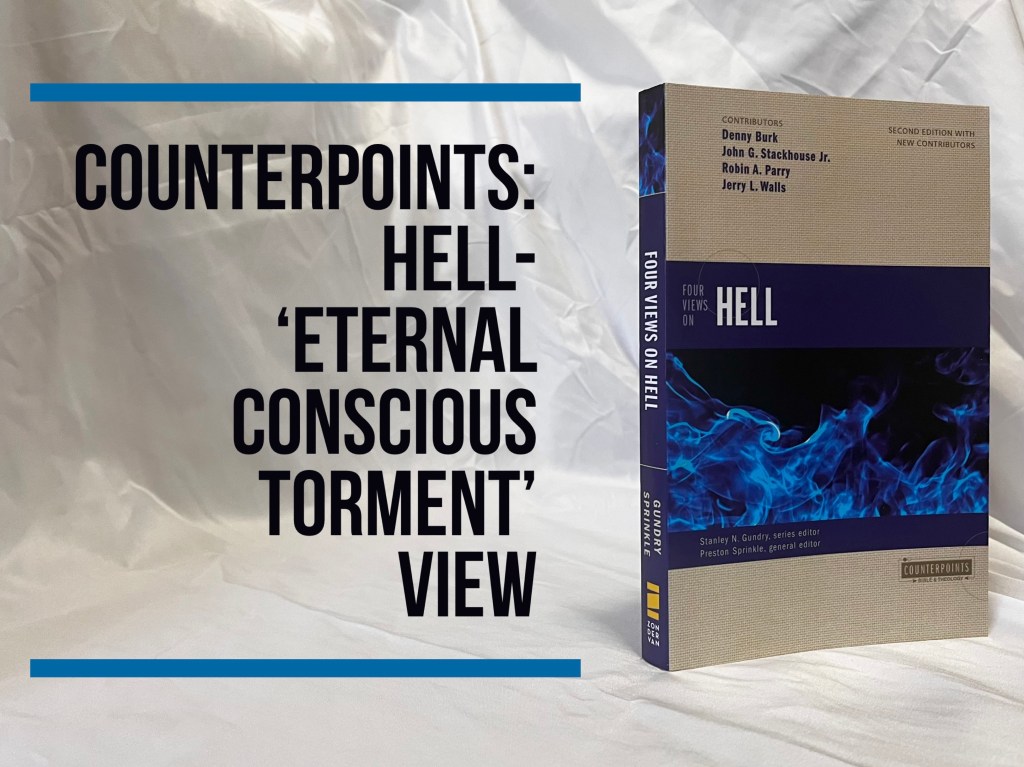
Counter Points is a series of books that bring together various Christian leaders and thinkers to debate differing view points within the church.
My goal in this series is to review each of the four points of view shared in the book ‘Counter Points-Hell’ so that you get exposed to different viewpoints that you may not have known even existed as well as share my thoughts as I encountered these various viewpoints.
Our first perspective on Hell is called the ‘Eternal Conscious Torment’ View. This view is held by Denny Burk in the book.
What is the ‘Eternal Conscious Torment’ View of Hell?
The ‘eternal conscious torment’ view of Hell is probably exactly what you grew up thinking about when you thought of hell. At the least, that’s what my experience is and from consuming media from our culture, that’s generally the idea most people probably have of hell.

In short, the ECT view of hell is as Denny describes: “being left in the presence of God’s wrath forever.” This is the traditional view of hell.
Hell is a literal place that lasts for all of eternity, where the pain and suffering you experience is the wrath of God against your sin.
What Did I Appreciate?
At first glance you may think, like many others that this view of hell comes off as very harsh. Yet what I appreciate about this view is that it exposes sin for what it is.
In a culture where sin is becoming glamorized and paraded, the idea that sin is cosmic treason against God, really shows just how serious our own sin is.
With this view in mind, the idea that God sent his Son to die as a payment for our sin really shines a light on not just how powerful Jesus’s death was as a payment but how precious his death was, as it is a sharp reminder that our sin is serious and Jesus’ death was the only option.
For any of us who have grown numb to the weight of our sin, a view like the traditional view of hell, wakes you up from your slumber and forces you to as John Owen says: “mortify your flesh.” “Be killing sin, or sin will be killing you.”
The second point this view brought out that I appreciated was highlighting the justice of God. Justice is a word most of us are familiar with thanks to our social justice workers. Here we gain a view of God who takes sin more seriously than we do.
Where the idea of a God as just may bring you comfort is when it comes to injustices that happen. When you see, for a heightened example, a mass murderer get caught and have to face the penalty for the crime they have committed, you are relieved because you know evil will not win. Evil must pay for what it has done. In this view, every crime, every blemish of evil will get what it deserves. Highlighting that God cares more about justice than we do.
Where Did I Struggle With This View?
The first area of tension I had was with the breakdown of the Valley of Hinnom. Now for those who are not familiar, the valley of Hinnom is the Hebrew phrase for the place that is usually referred to as hell. Denny starts here to set up the foundation of his view.
In Isaiah 66:22-24, we get the idea of a “new heaven and new earth” which is pointing to an eschatological reality for those who are believers. In the New heaven and New earth, these believers will no longer weep, there will be no conflict that results in bloodshed, there will be no evil. All nations will be represented proclaiming God’s glory.
For those who are not believers, they will end up in what is referred to as the valley of Hinnom “where Ahaz and Manasseh burned human sacrifices to the false God Molech”, (Denny Burk). The imagery here is where I disconnect. I know in the New testament, the place referred to as Hell is Ghenna, which was a literal place that the people of the day considered “god less.” It was vile and rank. It was so bad, that is was looked at as the place where God is not present. Because if God was present, there would be good there; but there is no good there, so in turn that means God was not present there. I wonder if that is the same way we should use the imagery of the Valley of Hinnom. These are literal places pointing to what a life without God, who is good, is like.
Second, Denny then goes on to describe the purpose of fire as imagery in hell. I had understood fire as a symbol of God “purifying” the unclean. The idea that heat can get rid of toxins.
There is no future redemption for the ones condemned to unending punishment. Isaiah 66:24 is the last verse in the book, and the implication is that the final word corresponds to their final state which is unending. This means that the punishment of the wicked is not disciplinary or restorative. Rather, it is a punitive measure to recompense the wicked for rebelling against God. The “continual burning” of the “consuming fire”(Isa. 33:14) of God. Does not purge evil but punishes evil.
Deny Burk(Counter Points: Hell)
Denny does go on to talk about Sodom and Gomorrah which I had at one point believed was God’s wrath, and even though I would still hold to that point of view, I would also view the burning of those two cities as a sort of “cleansing the world from the evil within.”
My last point of question was when it came to “Foundation 4: Matthew 25:31-46”
Here is where Denny breaks down his views on Hell as “eternal punishment.” And this is where my ‘Bible Project’ training kicked in.
According to the Bible Project time is split up into different ages. And specifically when Jesus talks about eternal life a better translation of that phrase would be “life unto the age.” I then wonder, how this concept of “life unto the age” plays into the idea of hell going on for eternity.
Denny quotes Rob Bell so I will too:
In a good number of English translations of the Bible, the phrase “aion of kolazo” gets translated as “eternal punishment,” which many read to mean “punishment forever,” as in never going to end. But “forever is not really a category the Biblical writers used.
Rob Bell(Love Wins)
Denny counters this quote by focusing on the word “punishment” where Rob’s point was taking issue with the word “forever.”
Here is where Rob may have a point. What does this word “eternal” mean in regards to hell?
Denny does make another interesting point following this talking about how if Hell is not punishment for eternity then what happens to Satan and his legion of demons? Do they also get redeemed?
This was such an interesting rabbit hole to go down but I will stop there.
Do You Think This View Is Right?
I believe that there is truth in this view.
God is a just God and the Bible makes it clear that He hates evil more than we do. And He is at work to overcome the evil in this world.
Where I have questions really comes down to the timeline of hell and even maybe a slight variation on the idea of hell being God’s wrath against sin.
I have no problem with Hell being eternal punishment. Our sin is “cosmic treason against a holy God.” Where I would have more questions is whether this punishment could be restorative. God is a God whose ultimate goal is to restore order back from the chaos. The end of Revelation takes us back to that original yet fulfilled vision from the Garden. Could this “holy punishment” be temporary? Could God punishing those who are evil doers be the very thing that calls them to repentance? And what happens if Hell is temporary? What does that mean for the army of Satan?
Along with my questions about the timeline of Hell, I believe the nature of God’s wrath is something often missed as we(I wonder if this is a Western problem) focus on aspects of God’s character like his omnipresence, omniscience, immutability, and so on.
Sometimes I find evangelical preachers viewing God as this supreme being who is present everywhere, and his presence everywhere comes off more like a super power than an actual sense of comfort which I believe is what the Bible is more trying to communicate when describing God in that way.
So with the nature of hell being God’s wrath. What if God’s wrath looks more like his distancing Himself from you? The way Pharoah’s heart is hardened is by God pulling Himself away. The way in which God shows grace is by pushing in. So when it comes to Hell being God’s wrath against sin, what if Hell is the place like Gehenna where God is “absent.”
Now for my Reformed friends who would drop their jaw at this, let me remind us of the paradoxical nature of theology. We believe free will and predestination coexist. We cannot explain it but it is true. I wonder if Hell is both the place where God is present but also where he is absent. Does it seem to contradict itself? Yes, but that’s how God is. We cannot explain every jot and tittle, but we accept it as God’s truth.
My default growing up has always been this view and I still hold to the ideas of it, I just hold them loosely and enjoy playing around with them.
This is the first part in a four part series going over the essays in the book: Counter Points: Four Views on Hell

Leave a comment