


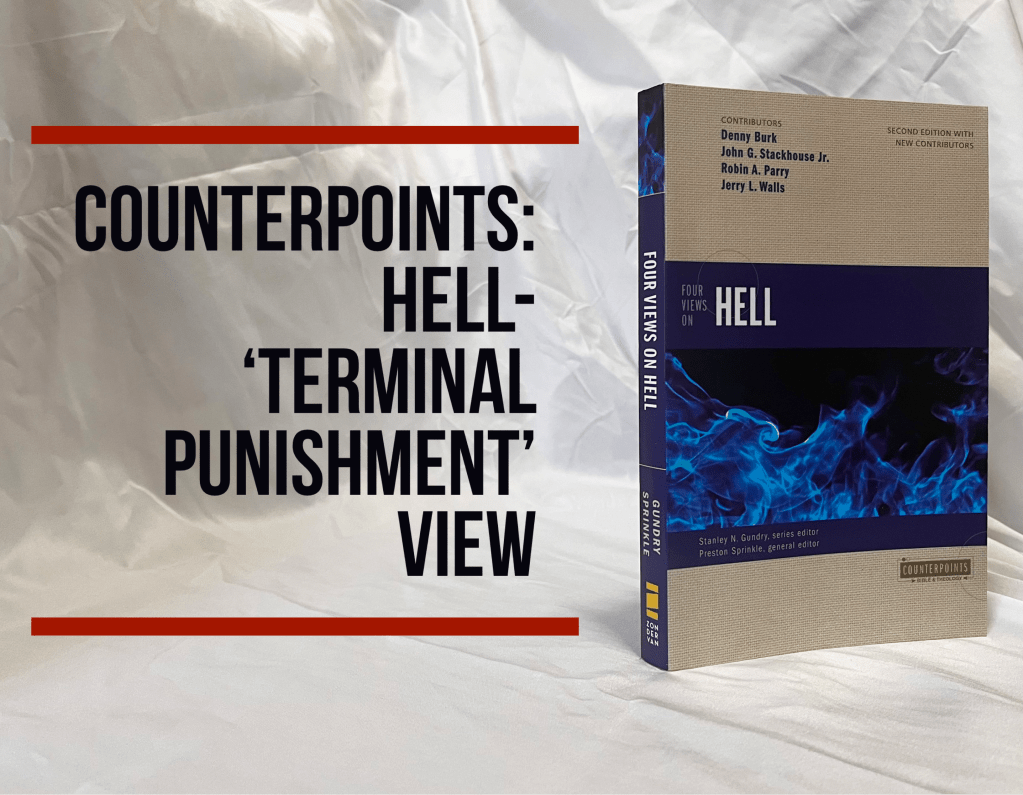
Counter Points is a series of books that bring together various Christian leaders and thinkers to debate differing view points within the church.
My goal in this series is to review each of the four points of view shared in the book ‘Counter Points-Hell’ so that you get exposed to different viewpoints that you may not have known even existed as well as share my thoughts as I encountered these various viewpoints.
Our second perspective on Hell is called the ‘Terminal Punishment’ View. This view is held by John G. Stackhouse Jr. in the book.
What is the ‘Terminal Punishment’ View of Hell?
The Terminal punishment view of Hell is best associated with the annihilationist view. In short the belief that hell does not last for all eternity but rather only exists for the time necessary for those who are in hell to pay for their sins.
The view that hell is a situation in which those who do not avail themselves of the atonement made by Jesus in his suffering and death must make their own atonement by suffering and then death, separated from the sustaining life of God and thus disappearing from the cosmos.
John G. Stackhouse Jr
What Did I Appreciate?
The very first piece of Stackhouse’s argument that I did appreciate was his just simple reasoning as to why hell would only be temporary.
Comparing his view to the first point of view we looked at, John takes question at why hell must last for all eternity.
Here he just asks the question: what could a mere mortal do that would logically justify their being tormented in hell for all the ages to come?
They suggest, in brief, that because God’s majesty and honor are of infinite quality, any sin against them deserves an infinite punishment. But with all due respect to such great figures in the tradition of the church, we yet must not take their conceptualizations for granted. Rather, we must submit any such idea to proper tests of both rationality and Scripture.
One can easily argue quite differently than did the medieval scholastics: that finite creatures can wreak only a finite amount of damage in and on the universe, and so a finite amount of suffering must suffice to atone for it.
John G. Stackhouse Jr.
Where folks from the ECT view would say because sin is ultimately crimes against God, it is “cosmic treason” deserving of eternal long suffering; Stackhouse makes the argument that because we are finite creatures we are only able to inflict so much damage and thus if we are “paying for our sin” in hell, then hell cannot logically last for all eternity. Even Jesus as a man, only experienced the wrath of God for all of humanity’s sin in a limited amount of time.
The second piece that I appreciated about Stakchouse’s arugement was his challenge on what “death” means in the Bible. Here is where his last paragraph is actually his best point of debate for his view.
Scripture speaks decidedly on one side: “the wages of sin is death”(Rom. 6:23) and death means, if nothing else, termination. The one thing death does not mean is “not dying.”
John G. Stackhouse Jr.
As someone who has grown up in the church, that line in Romans always had me puzzled, because being dead is a state of being. You are either dead or alive. And if the punishment for your sins is death, then that means your punishment for sin is you dying.
Where did this idea that our souls are by default “immortal”? I thought our very existence was temporary, and that the idea that Jesus grants you eternal life is where our souls become immortal. Yet with our traditional view of hell, everyone has “eternal life” just some spend it in heaven and others suffering in Hell.
Here is where the last point of appreciation comes in, which is where John makes you question where the idea that eternal punishment in hell even comes from.
“Down through church history Christians have taken for granted something that ought instead to have been questioned: the immortality of the soul.”
Where Did I Struggle With This View?
By the end I could understand the points John was making, but I did feel as if John constantly kept making assumptions of how things operated or making jumps that proved his point without properly backing up what he was saying or really fleshing it out.
The one point that really caught me was when John discusses Mark 3:28-29 where it speaks about “eternal sin.” John challenges you not to assume you know what eternal means, which I appreciate but he makes a claim that obviously the author did not mean that someone was sinning on and on for eternity, but rather that the effects of this sin are eternal.
Now as I wrote that last paragraph, I finally understood what John was trying to say but in the moment of me reading, this was the final nail in the coffin where I became annoyed by how John would explain his points but not in the best fashion. Granted, this could be the fault of me.
One of the glaring points that I struggled with though was when John made the claim that we are “sentimental about forgiveness.” According to John the reason we have prolonged God’s wrath in Hell is because we as humans like to draw things out and we would rather not deal with the issue right at hand. We do not take sin “seriously enough”, says the guy whose reasoning for hell not being eternal was that our sin is not that big of a deal because we are so finite, even though what his objectors would say is that our sin is so serious that it deserves suffering for eternity. It seemed as if John just became the Spider-Man Meme.

Yet his point of contention with “sentimentalizing” made me wonder what he thought of Jonah and God’s point of tension.
Does John believe God was being to “sentimental” as he waited patiently for the city of Nineveh to come to repentance? Was John in agreement with Jonah that God is too “kind hearted” and should just wipe these evil doers out in an effort to “take sin serious.”
At this point, I began to question what does John actually believe? I felt his breakdown of the ‘terminal punishment’ view was muddy. I left scratching my head and wondering how he would describe God.
Do You Think This View Is Right?
I believe that there is truth in this view. Even in how we can be too soft on sin as John points out, I just would focus my attention in how we deal with sin in our everyday regular lives not on how quickly God puts an end to sinners.
Stackhouse ends his section by quoting Chesterton saying: “Hell is the furious love of God.”
I think this a cool quote but in the context of this debate, I struggle to accept that if hell is the furious love of God, according to Stackhouse’s view, God’s love is so intense that in annihilates you out of existence. That is a hard one to wrap my mind around. But I am interested in seeking to understand his view further.

Leave a comment