


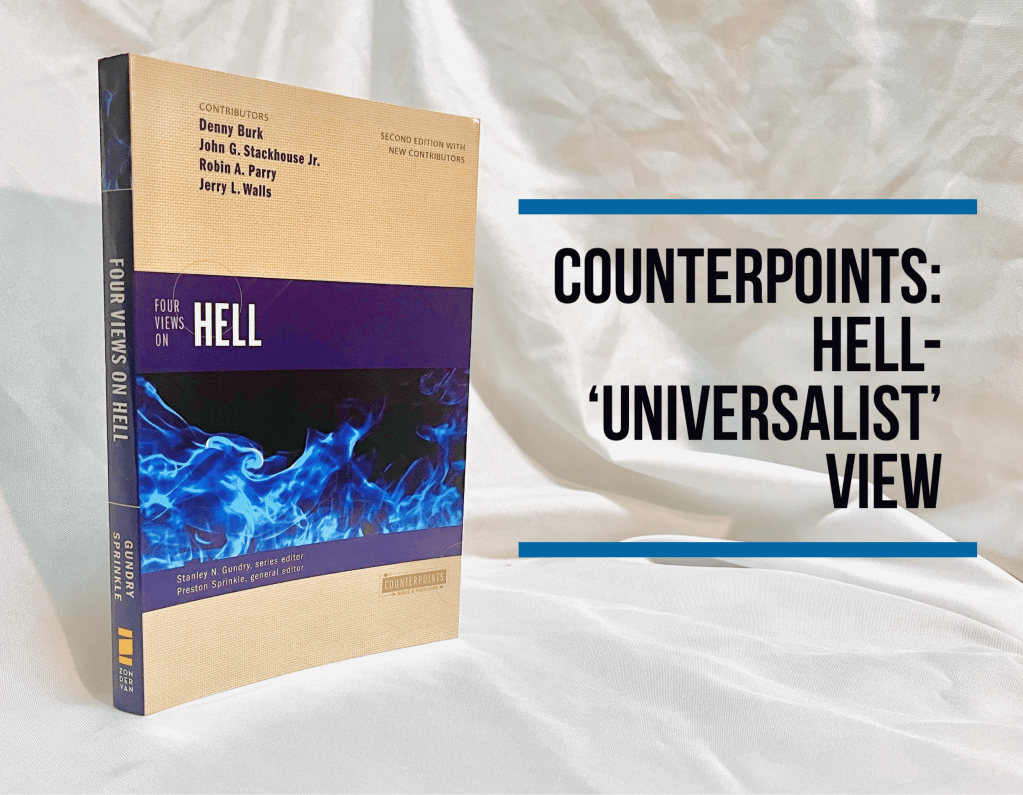
Counter Points is a series of books that bring together various Christian leaders and thinkers to debate differing view points within the church.
My goal in this series is to review each of the four points of view shared in the book ‘Counter Points-Hell’ so that you get exposed to different viewpoints that you may not have known even existed as well as share my thoughts as I encountered these various viewpoints.
Our third perspective on Hell is called the ‘Universalist’ View. This view is held by Robin A. Perry in the book.
What is the ‘Universalist’ View of Hell?
The Universalist view of Hell is as Robin says: “the view that in the end God will reconcile all people to himself through Christ.”
This view is built around the heart of God to reconcile all of the world to Himself. In verses like John 3:16 we hear phrases like: “For God so loved the world that He sent His one and only son.” This view is developed on the back of getting to the intention of why God has chosen to send his son; that being to save all of his creation from the plague of sin and death.
What Did I Appreciate?
The first thing that I appreciated in Robin’s argument was his self awareness of how debates can tend to go. Specifically debates regarding doctrines or topics in the Bible where we see people only using passages of Scripture that clearly support their point of view.
This is a very easy and natural reaction to have when you are in a debate. Your mind immediately jumps to your best arguments that make it seem so clear that your view is right and the opposing view is clearly wrong.
Showing that a specific passage seems at face value to support your particular view of hell is not going to settle the issue. Everyone in this discussion who thinks that the Bible is not contradictory will need to interpret some passages in ways that run counter to their prima facie meaning.
Robin A. Perry
Robin then goes on to explain why we need a “Trinitarian, gospel shaped narrative” reading of the Bible.
In a day and age where the Bible App gives us our verse of the day and pastors encourage congregants to “just aim to read one verse a day”, so many of us have missed out on the grand narrative of scripture. We have not understood the over-arching story of the Bible that truly captures the heart of Christianity, of Jesus Christ. And Robin beautifully points us back to that. It’s so easy, especially for us theology nerds to fixate on reading the Bible looking for confirmation bias on our favorite doctrines when really the Bible does not care to give you ammo to win a debate but rather wants to capture your heart and mind to the beauty of God’s written word.
Because of this I can agree with the logic when Robin says: “The grand story that runs from Genesis to Revelation. I shall argue that when located in the plot line of Scripture, a universalist doctrine of hell makes good sense.”
Second
If your theology of hell is not compatible with God’s love for the damned, then your theology of hell is wrong.
Robin A. Perry
Robin does an excellent job of pointing out one of the easiest traps to fall in. The trap of polarizing God’s justice with his love. By our very own nature, we as finite humans tend to struggle with more nuanced and complicated topics so we lean towards one side or the other, giving us plenty of opportunity to fall into either one ditch or the other.
We must not polarize the characteristics of God that may lead people to believe in ideas like: “there’s the God of the Old Testament and the God of the new.” These ideas are dangerous as they portray God as this changeable figure who was a grumpy old man in the sky and then his hippie loving side eventually came out further down the road.
Again, going back to that grand narrative view when reading Scripture, the God of the Bible who is both the God of love and divine justice, is consistent throughout the pages of Scripture when we honestly read the Bible on its own terms.
Lastly, when it came time for Robin to actually bring up the evidence for his particular point of view, I appreciated his honesty.
What does the Bible say? Well, it does not directly address the issue. There are no biblical texts that say death is a point of no return, but neither are there texts that unambiguously say that one can repent after death.
Robin A. Perry
To, in a debate, be honest that your view is not directly supported in Scripture and that you are having to rely on Scripture “hinting” at it, is truly honorable. Many would I believe just find scriptures and twist them to mean what you want them to say. Robin does not do that and I highly appreciate his transparency.
Where Did I Struggle With This View?
As I just stated, Robin is honest that no texts directly support his view of universalism. That is where, no matter how much I would like for his view to be true, I cannot really get behind it.
The big instance and the only instance I would really like to point out in his argument that really nailed this in the coffin for me was when he quotes Luke 15:4
On the one hand, one has to ask after the theological rationale behind the mainstream claim that death is the point at which one’s fate is forever fixed. Why would that be the case? Is it impossible for people to change their ways and to repent after death? Does death somehow fix us in some eternally sinful state? This seems highly unlikely. So might it be that God simply chooses not to seek the lost after the barrier of death is crossed? But again, why? Has God stopped loving them? Does he now no longer want them to turn from sin back to him? Will he now ignore any genuine repentance or faith? Again, all this seems out of kilter with the God of the gospel, the God who keeps on seeking a lost sheep “until he finds it”(Luke 15:4).
Robin A. Perry
Do You Think This View Is Right?
The grand story that runs from Genesis to Revelation. I shall argue that when located in the plot line of Scripture, a universalist doctrine of hell makes good sense.
Robin A. Perry
Though the universalist in a logical sense may make sense and may be the one I would love to be right because I would love for all those who are lost to be found; I cannot say that according to Scripture I find a strong enough case to imply that after death, people still have a chance to be reconciled to God.
Robin covers passages like: Mark 9:42-50; Matthew 25:31-46; 2 Thessalonians 1:5-10; Revelation 14:9-11 & 20:10-15; and in all of his explanations of those passages, though I may see God’s heart to redeem all people, I am not convinced that all people will be redeemed and that is not fault to God but rather the reality that sin is a vicious disease that captures not just people’s actions, but their hearts and minds.
There are some people who simply put, do not love God. They do not love good. And apart from God’s intervening work they will not love God.
Now, as a former and still to some degree Calvinist, do I believe God can give people the faith to believe? Do I believe in the doctrine of “irresistible grace”? Sorta, but even if I believe God in order to save people, used his irresistible grace, I do not believe that everyone will be saved.
There are some who are made for destruction. Why is that?
I have no idea other than for God’s purposes. Could I be convinced a different way? Absolutely. As I am writing this, I am seeing my former Calvinist brain kicking in, but either way. Calvinist or not; there is simply not enough substantial evidence that there is any hope for people after they die. They have chose their path. And I am comfortable with the fact that some people, no matter how good God is, will not love God.

Leave a comment