


Around this time of year, Christmas music is blaring from every which direction; and in my house Christmas music covered by the acapella group Pentatonix is especially being played from every which direction.
Along with Christmas music like the classics “Rudolph the Red Nose Reindeer” or “White Christmas” there are many Christmas songs that have a degree of religion attached to them.
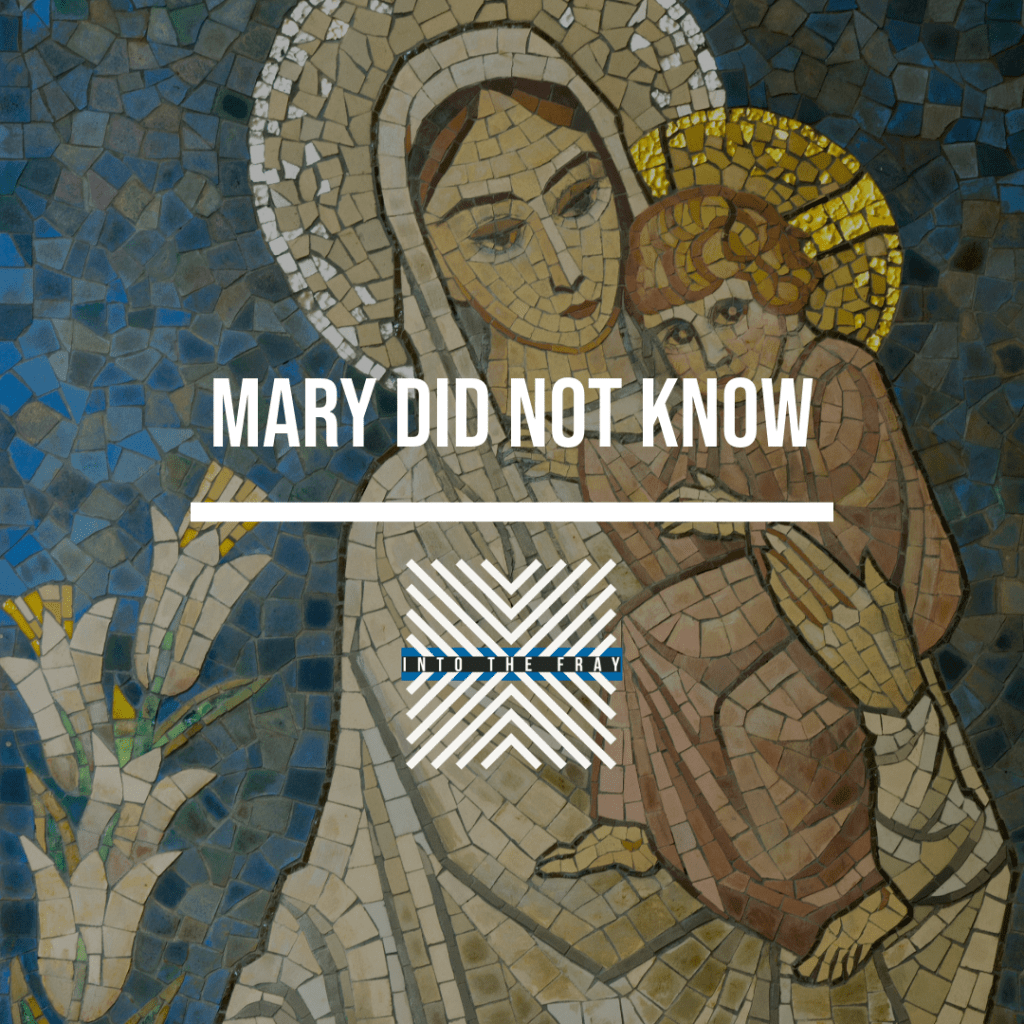
One of these songs that gets the most play around this Christmas season is “Mary Did You Know?”
History of ‘Mary Did You Know’
The lyrics for the popular Christmas song was written by Mark Lowry. Mark originally intended this song to be a sort of monologue in between scenes for his churches Christmas play and came about from him pondering what type of conversation he would have had he the chance to speak to the mother of our Lord over coffee.
Well, my Pastor asked me to write the Christmas program for our church, called The Living Christmas Tree, and I wrote some monologue to go in between the songs. I started thinking and wondering if Mary realized the power, authority and majesty that she cradled in her arms that first Christmas. I wondered if she realized those little hands were the same hands that scooped out oceans and formed rivers. I just tried to put into words the unfathomable. I started thinking of the questions I would have for her if I were to sit down & have coffee with Mary. You know, “What was it like raising God?” “What did you know?” “What didn’t you know?”
Pushback On the Song
If you are not aware, many Preachers at Christmas season will take this opportunity to give their “hot-take” about why certain Christmas songs or Nativity scenes are wrong. There is nothing wrong with preachers doing this though I personally get annoyed when they act like they are the only ones who have made this observation before. In regards to songs like “silent night” many preachers will make the comment that the night was in fact not silent, because of all the animals around the manger and the fact that a newborn baby is never silent.
Along with the deconstruction of the “silent night” set up comes the deconstruction of our classic “Mary Did You Know?”
The pushback on this song comes from an analytical reading of Scripture that believed Mary did in fact know because God told her.
In the sixth month, the angel Gabriel was sent by God to a town in Galilee called Nazareth, to a virgin engaged to a man named Joseph, of the house of David. The virgin’s name was Mary. And the angel came to her and said, “Greetings, favored woman! The Lord is with you.” But she was deeply troubled by this statement, wondering what kind of greeting this could be. Then the angel told her, “Do not be afraid, Mary, for you have found favor with God. Now listen: You will conceive and give birth to a son, and you will name him Jesus. He will be great and will be called the Son of the Most High, and the Lord God will give him the throne of his father David. He will reign over the house of Jacob forever, and his kingdom will have no end.”
Mary asked the angel, “How can this be, since I have not had sexual relations with a man?”
The angel replied to her, “The Holy Spirit will come upon you, and the power of the Most High will overshadow you. Therefore, the holy one to be born will be called the Son of God. And consider your relative Elizabeth—even she has conceived a son in her old age, and this is the sixth month for her who was called childless. For nothing will be impossible with God.”
“See, I am the Lord’s servant,” said Mary. “May it happen to me as you have said.” Then the angel left her. (Luke 1:26-38 CSB)
Why would we question, like the song does, if Mary believed what God told her about her promised son Jesus? Why sing a song, especially in church settings that undermines Mary’s faith in God and her close relationship with the Father?
The Humanity of the Bible
There is a statement that was signed in 1978 in Chicago famously known as the “Chicago Statement on Biblical Inerrancy” that was signed by 200+ evangelical Pastors/church leaders all coming around this doctrine that the Bible is the inerrant(without errors) Word of God. Now, I personally have no qualms necessarily with this statement though Christians like Pete Enns of the “Bible for Normal People” podcast and Youtube channel would offer fair pushback to the label “inerrancy.”
My personal wrestle with this idea that the Bible is inerrant does fall into some of what Pete has thankfully brought up as an issue though.
My understanding of the Bible being inerrant for many years was used more as a way to defend the truth of the Bible from skeptics who doubted the reliability of the Bible. The doubt of the reliability of the Bible comes from its apparent contradictions and differing perspectives from page to page.
An example of this comes just within the first two chapters of the Bible which offer two opposing or at the least different accounts of creation.
Genesis 1 has this more grand view of creation starting with the earth being formless and void and ending the actual act of creating with the sixth day where Yahweh makes Adam(mankind)(male and female) and then commissions them.
Genesis 2 starting in verse 4 offers a different creation account that seems more dialed in on the creation of a specific male and female named Adam and Eve. The ordering of how all things were created do not track the same way as they did in chapter 1 and the account in chapter 2 reads very differently than chapter 1.
To honest readers this would come off as confusing at the least and contradictory(maybe even untrustworthy in regards to banking your belief of the origin of the universe) at the most.
This is not the only seeming contradiction, the Gospels offer 4 differing perspectives of the life of Jesus, each written for differing purposes and each highlighting differing “facts” or even chronologies of how things took place.
Does this mean the Bible is Untrustworthy?
“By no means” as Paul would say in Romans. What I believe many modern readers of the Bible specifically within the context of modern American Evangelicalism would struggle with is understanding the complexity of the Bible.
The Bible was never meant to be this black and white, truth versus lies take on the world.It was not meant to be a science textbook or a book that we go to to win theological arguments against our theoretical enemies.
The Bible is a collection, a library of books of all differing genres including poetry, prophecy, apocalyptic literature, wisdom literature, letters and biographical accounts that all together communicate a singular message, albeit story by which we can live by.
In Walter Isaacson’s biography of Steve Jobs he details how Steve, in search for an inner peace, rejected Christianity and ran to Eastern religions like Buddhism and Hinduism. In Steve’s trip to the East, he learned that how we think in the West is contrary to how much of the Eastern world thinks.
The West values intellect. We value rational thought.
The East values intuition. They value a way of living that requires you to be in connection to a deeper part of you than just your mere mind.
I believe that is a good way to understand the Bible. The Bible is 100% trustworthy and reliable. It is 1000% God’s Inspired Word but it is not God’s Word in the way we think about it being God’s Word.
We believe it’s God’s Word in a “God said, I believe it, that settles it kind of way.”
But God’s Word according to the way ancient Jews read it was something to wrestle over. It was not as clear cut as the division between Calvinism and Arminianism. It was not as stark a contrast as Protestantism vs. Catholicism.
The Bible, God’s word was complex and needs to be mediated on and wrestled with.
God’s word though true, was something that you should question and pull on.
Why?
Because God is a personal being, He Himself is not some robot in the sky like we more often than not treat Him. We treat Him as if he is not someone who moves and shifts. We treat Him as if he does not commune. Yet in the early pages of Genesis, the Elohim walked with mankind in the evening of the day. They conversed, they related to one another.
When Abraham pleads for God to have mercy on the city, God does not say “Were you not listening, Obey what I said, ask no questions and stop talking to me.” No, instead Yahweh, graciously answers back every question showing his compassion, his relatability.
Yahweh is fully God but when he comes down from his throne room in Heaven as the Son of God, he is also fully human.
Jesus, the God-man bears the weight of the world that we know all too well. He eats and decomposes, he inhales and exhales, he listens and he talks and he fully embraces the life that humanity has continually taken on.
How Does This Connect to Mary?
Too often when we read accounts in the Bible we, because of our embrace of doctrines like inerrancy, forget the humanity layered throughout the pages of the Scriptures and we end up taking human moments and turning them into God moments that were not necessarily meant to be God moments.
Did Mary know that her son was the Messiah?
I believe so.
But so do I.
Yet everyday I wrestle with my own amazement at what that actually means in my day to day.
The Jews were told by God a savior would come, they expected it, they waited for it and when He came, they would have never known that the Savior of the world would have come the way He did.
Might the same be true for Mary?
If we are only taking what is on the pages of Scripture as what actually happened then there is a lot room for Mary to have misunderstood what it meant for her son to be the savior of the world.
Mary grew up in a traditional Jewish context. Performing miracles was not unheard of but it was not popular. She may have been surprised at the feats Jesus performed.
Mary, did you know
That your baby boy will one day walk on water?
Mary, did you know
That your baby boy will save our sons and daughters?
Did you know
That your baby boy has come to make you new?
This child that you've delivered
Will soon deliver you
Mary probably did not know that her Son would literally walk across water as if it was a sea of glass.
She probably did not know that Jesus would deliver our sons and daughters 2000+ years later.
She probably did not know that Jesus came to not just build a new Kingdom(as they expected the Messiah to do) but would accomplish this by making she(herself) new.
Mary was human, just like we all are. Prone to doubt, prone to wrestle, prone to wander as the famous song “Come Thou Fount” professes.
We say in response to this famous song “of course Mary knew because God told her” yet God has gave us 66 books worth of teachings to us that we fail to remember and to really grapple with in our hearts and souls.
Knowing is Not Understanding
Knowing theoretically, knowing in your mind is not the same as understanding it in your soul.
This is the same observation Steve Jobs had about how we tend to think about the world post enlightenment compared to the rest of the world.
We may know the sky is blue, but we do not understand how the light hits whatever molecules are in the air to give us the perception that the sky is blue.
I did not even understand how the sky is blue enough to write that sentence and as an example.
Just because we know, does not mean we understand.
And just because we are told does not mean we listened to the point of understanding.
Summary
Did Mary Know?
yes.
no.
maybe a little.
I do not know. But I know that everyday I wake up and I read God’s Word and yet I still walk through my day not fully understanding what it is that God just said through the pages of Scripture.
As humans we are prone to forget. We are prone to need time to really grapple with what it is that is.
Maybe Mary did too.
Maybe at the end of her life, she sat in amazement at what her son turned out to be. Maybe she knew theoretically in her mind her son was the Messiah but did not know just what that means on a ground level.
Maybe we forget that God knows we are human. Maybe this song is a reminder for us to embrace our humanity, our finiteness(if that’s a word) and be in awe of what God has done.

Leave a comment